
Quick Summary
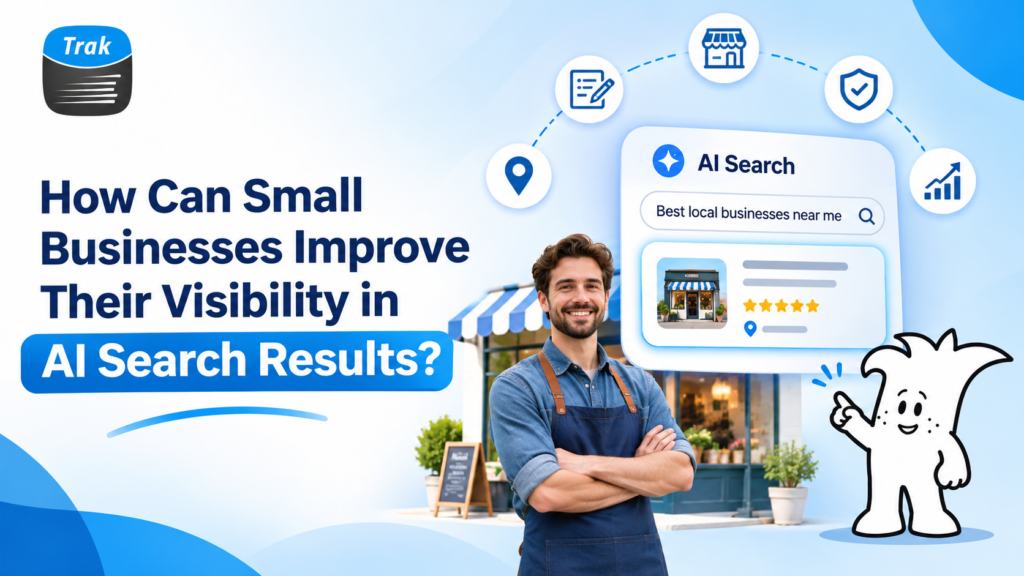
Small businesses can improve AI search visibility by keeping important pages crawlable, explaining services and service areas clearly, answering real customer questions, maintaining accurate business listings, earning credible reviews and mentions, and measuring qualified leads, not just AI mentions.
A customer might ask an AI search tool, “Who can repair my heat pump near me?” or “Which marketing agency understands local service businesses?” The answer may name a few providers, describe their services or point to sources. If your business is missing, it is tempting to chase a new technical trick.
That is rarely the best first move. For most small businesses, visibility starts with a simpler question: can a stranger, and a search system, quickly work out what you do, who you help, where you operate and why you are worth considering? At Trak Marketing, we approach AI search optimization for small businesses through the work that makes those answers clear: solid AI SEO, specific content, accurate business details and proof that holds up.
What the Early Research Tells Us
BrightLocal’s 2026 Local AI Visibility Study analyzed more than 200,000 localized prompts and 1.9 million citations. It reported that business websites accounted for 42% of citations, while 93% of unique source domains were business sites. That makes a useful case for improving your own pages instead of relying only on directory profiles.
The study also points to a limitation: AI answers are not stable rankings. Result sets can change with the wording, location and time of a query. A mention on Tuesday is not a permanent position, and a single test is not a dependable performance report.
You do not need an “AI SEO hack.” Make your most useful business information easy to find, understand, and verify. Then improve the gaps you can actually observe.
Semrush analysis of 10,000 domains found a strong correlation (0.86–0.87) between organic keyword footprint and AI citations across platforms. Correlation does not show that expanding keyword rankings automatically creates AI citations. It does support a sensible investment: keep building relevant search coverage instead of abandoning SEO for an AI-only playbook.
Start With the Pages Customers Need to Make a Decision
Before publishing another broad “ultimate guide,” inspect the pages closest to revenue. For a service business, that usually means the homepage, top service pages, contact page and any real location pages.
1. Make Your Offer Unmistakable
A service page should say what the service is, who it is for, where it is available and what a customer can expect. Explain what is included, how the process works, what can affect cost and what the next step looks like. “Quality solutions tailored to your needs” could describe almost any provider. “Emergency boiler repair in Bristol, including evening call-outs” tells the right customer much more, if that claim is accurate.
2. Give Each Important Service Its Own Useful Page
Avoid making one page carry every service, audience and town. Separate pages only when there is genuinely distinct information to offer. A page for each town with swapped place names is not a local strategy; it is thin duplication. Include local service constraints, examples, staff coverage or customer questions where they are real.
3. Answer High-Intent Questions in Plain Language
Useful subjects include pricing, timeframes, eligibility, preparation, comparisons and common mistakes. Give the short answer early, then explain the conditions or exceptions. Readers should not have to dig through a long introduction to find out whether you serve their area or what a service includes.
This approach also supports Answer Engine Optimization (AEO), where clear, useful answers make your content easier to understand and reference. Our guide to Answer Engine Optimization (AEO) explains how to structure content around the questions people ask.
Use FAQs when they clarify an actual decision, not to cram in every variation of a keyword. A focused answer can belong in a service page, a standalone guide or a short FAQ, depending on what the reader needs.
4. Keep Local Information Aligned
LocalBusiness structured data documentation explains the fields that can help describe eligible businesses. Markup must match visible, accurate page content. Structured data can help machines interpret a page, but it is not a ticket to an AI recommendation. Review Google’s LocalBusiness markup guidance.
Keep your Google Business Profile current and use the right categories and services.
5. Show Real Evidence Instead of Superlatives
If you say you are experienced, show the work. A case study should explain the starting situation, what changed, how long the work took and what was measured. Label estimates and client-reported outcomes honestly. Add team expertise, relevant certifications and testimonials only when they are genuine and permitted to be shared.
Invite customers to leave honest reviews without scripting the wording. Respond to complaints like a business owner, not a reputation-management template. A thoughtful reply that addresses a specific issue is more credible than repeating “We value your feedback” under every review.
6. Earn Mentions Where Your Customers Already Look
Contribute useful expertise to trade associations, community organizations, local publications and partners in your field. A mention makes sense when the relationship and context are relevant. Skip bulk directory submissions, paid-link schemes and manufactured awards. A pile of low-quality mentions can consume time without giving customers a reason to trust you.
Related Reading
Google’s guidance for AI features and your website says the usual Search fundamentals apply to its AI experiences. Google does not require special AI schema or an llms.txt file for inclusion. Be cautious with vendors promising an undocumented “AI ranking factor.”
Tools Worth Using and When to Use Them
You do not need a stack of subscriptions to begin. Use tools to answer a defined question, not simply to collect another score.
- Google Search Console: Start here for search queries, impressions, clicks and indexing checks. It will not report every AI answer, but it helps identify pages already earning search visibility and questions people use.
- Google Business Profile: Use it to keep service details, categories, hours and customer-facing information current. It is particularly relevant when local discovery is part of the buying journey.
- Google Analytics: Set up meaningful conversion events for calls, enquiry forms, bookings or sales. Referral attribution can miss AI-assisted journeys, so do not treat its AI referral line as a complete count.
- Semrush or Ahrefs: Choose one if keyword discovery, competitor research, backlink review or site auditing is taking too much manual time. AI visibility features, coverage and plan limits vary; review methodology before comparing scores.
- Screaming Frog SEO Spider: Useful for crawling a site to find broken links, title issues, redirects and internal-link gaps. A small site can often begin with the free version.
For a lean setup, Search Console, Business Profile, Analytics and a simple tracking sheet are enough to get moving. Add paid software when you know which repeated task it will improve.
Also Asked: Use question clusters to generate content ideas. Check those ideas against real customer needs before creating pages; related questions are not automatically useful topics. You can also compare this workflow with our guide to getting mentioned in ChatGPT Search.
A Workable Routine for Tracking AI Visibility
Create 10–20 prompts that reflect what a likely customer would actually ask. Include service, problem, location and comparison wording. For example: “Who installs commercial security cameras in [city]?” is more diagnostic than “best businesses.” Keep the prompt set stable for comparison, and add new prompts only when your offer or market changes.
- Record the platform, prompt, date, location, whether the business appears, cited sources and competitors mentioned.
- Repeat the same checks periodically. Treat each answer as a sample, not a ranking.
- When your brand or a competitor appears, inspect the cited pages. Look for concrete details, third-party context and helpful explanations.
- Track website visits, qualified enquiries, calls and closed business alongside mentions. Ask new leads how they first heard about you. If you are weighing organic work against immediate lead generation, see how SEO and Google Ads can work together.
- Use the findings to fix one meaningful gap: a missing service detail, weak page, incorrect listing or unanswered customer question.
A practical dashboard should not stop at mentions. If visibility rises but the enquiries are irrelevant, revisit the prompts and the pages being surfaced. If leads improve but the AI referral source is invisible, the campaign may still be contributing. Use more than one signal.
A Realistic First Month
The goal is not to publish the most pages. It is to make the right information easier to find and trust, then see whether that work brings better conversations with potential customers.
- Week 1: Review the homepage, two key service pages, local listings and crawl/indexing basics.
- Week 2: Improve one revenue-critical page and publish genuinely useful answers to recurring customer questions.
- Week 3: Add a substantiated project example or credentials, and request honest reviews from recent customers.
- Week 4: Run your prompt checks, inspect analytics and lead quality, then choose the next improvement based on what you learned.
Frequently Asked Questions
What Is AI Search Optimization for Small Businesses?
It is the process of making your business and website easier for AI-powered discovery tools to understand, verify and potentially reference. It combines useful SEO, accurate business details, credible proof and clear answers.
How Do I Get My Business Mentioned in ChatGPT or Google AI Results?
Make your core pages useful and crawlable, maintain accurate business information, earn genuine reviews and relevant mentions, and cover the questions customers ask. No legitimate tactic guarantees inclusion or a particular placement.
Does AI SEO Replace Traditional SEO?
No. Search fundamentals remain important. Technical accessibility, useful content, clear page structure and matching customer intent help both people and search systems.
Do I Need an llms.txt File or Special AI Schema?
Google says neither special AI markup nor llms.txt is required for its AI search features. Use structured data only where it is supported, accurate and consistent with visible content. Check other platforms’ current documentation for their own requirements.
How Long Does AI SEO Take to Show Results?
There is no reliable universal timeline. Fixing an accidental crawl block differs from building a reputation or broader topical coverage. Monitor technical fixes and content performance over time without promising a set date.
Which Pages Should I Improve First?
Start with the homepage, highest-value service or product pages, About page and contact or location information. Prioritize the pages closest to a customer decision.
Can I Track AI Visibility Without Paying for Software?
Yes. Use a consistent prompt sheet, Search Console, Analytics and your business profile. Manual checks are imperfect, but they can reveal practical content gaps at no subscription cost.
What Matters More: AI Mentions or Leads?
Leads and revenue are closer to the business outcome. Mentions and citations can help explain discovery, but they are intermediate signals and can be inconsistently measured.
Build Visibility That Can Stand Up to Scrutiny
There is no reliable shortcut to being named by an AI system. The better investment is to make your business specific, findable and credible wherever customers research. At Trak Marketing, we connect search strategy, content and measurement to business goals. Explore Trak Marketing to see how we can help strengthen your online presence.